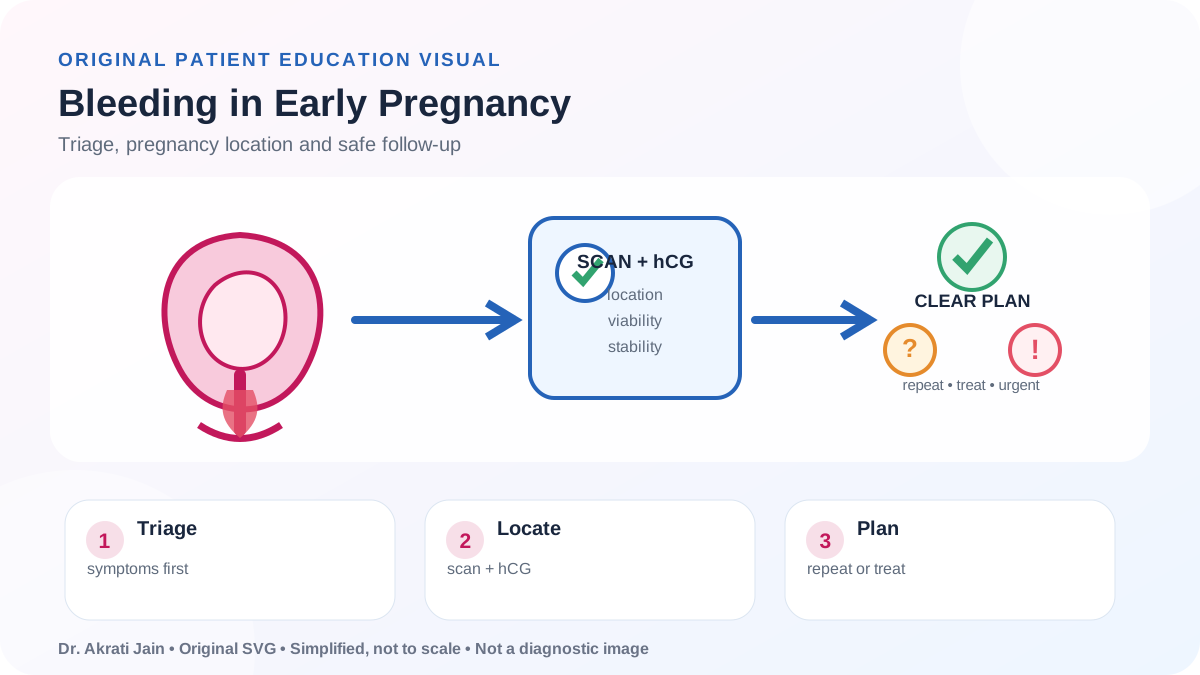
Bleeding or pain in the first trimester is common, but the cause cannot be judged safely from the amount or colour of bleeding alone. Assessment focuses on your stability, pregnancy location and whether the pregnancy can be confirmed as developing normally.
NICE early-pregnancy guidance updated in June 2026
The current NICE pathway emphasises safe diagnosis, access to early-pregnancy assessment and avoiding a premature diagnosis from one very early scan.
- Transvaginal ultrasound is usually the most informative scan for locating an early pregnancy; transabdominal scanning may be used when needed, with its limitations explained.
- When viability is uncertain, measurements and repeat-scan intervals matter. A repeat scan is often safer than making an immediate diagnosis from borderline findings.
- Pregnancy of unknown location requires follow-up until the location or outcome is clear; symptoms take priority over a single hCG value.
- NICE changed anti-D recommendations in June 2026: local practice should follow the current gestation- and management-specific protocol rather than older blanket rules.
What the bleeding may represent
Possible causes include implantation-related spotting, cervical bleeding, a subchorionic collection, miscarriage, ectopic pregnancy or, less commonly, infection or another pelvic condition. Symptoms overlap, so the diagnosis is based on assessment rather than appearance alone.
A pregnancy test may remain positive for some time after a pregnancy has stopped developing. Likewise, bleeding can occur in an ongoing pregnancy.
What happens during assessment
The clinician will ask about gestation, pain, bleeding, previous ectopic pregnancy or miscarriage, fertility treatment, blood group and current medicines. Examination is tailored to symptoms and consent.
Testing may include a transvaginal ultrasound, blood count, blood group and serial serum hCG. If the scan is too early to confirm location or viability, a planned repeat assessment is often the safest next step.
Understanding scan uncertainty
An empty uterus on a very early scan does not automatically mean ectopic pregnancy or miscarriage. Dates may be uncertain, especially with irregular cycles. A pregnancy of unknown location is a temporary classification that needs follow-up.
Waiting for an appropriately timed repeat scan does not harm the pregnancy. You should receive clear safety-net instructions and a contact route while waiting.
Treatment and follow-up
Treatment depends on the diagnosis. An ongoing intrauterine pregnancy may need observation only. Miscarriage care may be expectant, medical or surgical. Ectopic pregnancy may be observed, treated with methotrexate or managed surgically depending on stability and findings.
If you have bleeding with a confirmed intrauterine pregnancy and a previous miscarriage, your clinician may discuss progesterone according to current guidance and your individual circumstances.
Questions that change the care pathway
Is the patient stable?
Pulse, blood pressure, pain, faintness and the rate of bleeding determine whether emergency treatment is needed before detailed testing.
Where is the pregnancy?
Confirming an intrauterine pregnancy is central. Until location is known, ectopic pregnancy remains part of the safety assessment.
Is the result definitive?
Borderline ultrasound findings should be confirmed with repeat imaging or senior review rather than rushed into a final diagnosis.